
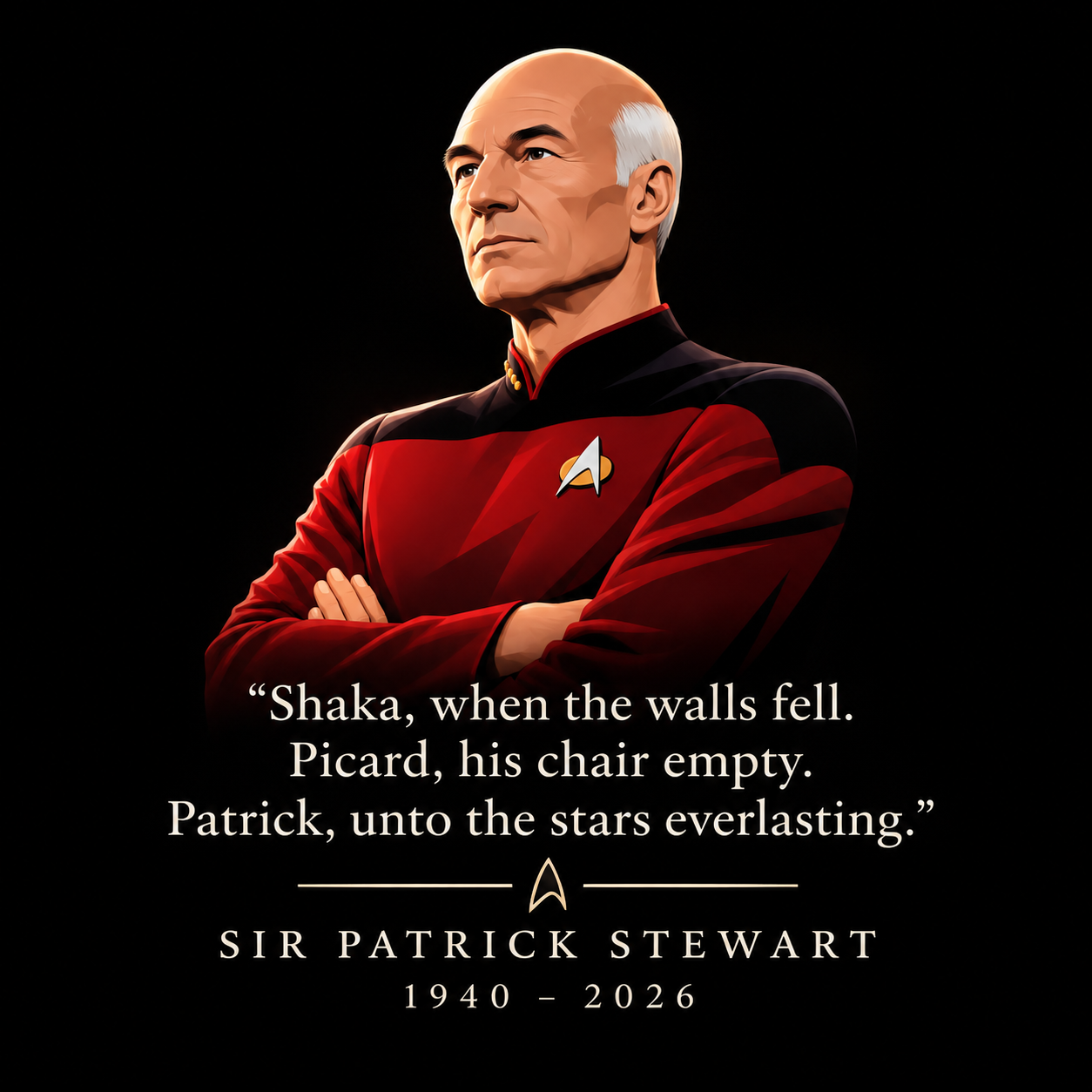
I grew up in a fairly strict household where television was tightly controlled and actively supervised. Between 0600 and our strictly enforced 2030 bedtime (yes, even as teenagers), our viewing options were limited to cartoons, comedy (mostly BBC, but also The Addams Family, Acropolis Now, Hogan's Heroes and M*A*S*H), music videos and science fiction.
And not just any science fiction. The really good stuff.
Doctor Who. Star Wars. E.T. Knight Rider. The original Star Trek series.
And then, in the late 1980s, came the bedtime-curfew-breaking Star Trek: The Next Generation (ST:TNG). This was a hard-fought privilege, secured after I was caught secretly watching the first season from the shadows of the kitchen doorway.
So, from season two onwards, for one glorious extra hour every Thursday night, my siblings and I were allowed to stay up and watch the adventures of the USS Enterprise under the leadership of one Captain Jean-Luc Picard.
Let me tell you how little this science-fiction diet helped me relate to my peers at school.
While other children debated the latest soap opera dramas and pop star romances, I had absolutely no idea what they were talking about. "We're not allowed to watch that" was something I said in the schoolyard pretty much every day of primary school.
Of course, I also had to explain to visiting friends just who the life-sized poster of Deanna Troi on my bedroom wall was.
Imagine ten-year-old me, enthusiastically explaining to another ten-year-old girl, who was happily playing with my Barbies, that Deanna Troi was a member of the Enterprise's bridge crew, sat right next to the captain, came from the planet Betazed and was a half-human, half-Betazoid empath.
Dear reader, my enthusiasm for adventures aboard a starship in outer space was not shared by my peers.
But my rather unusual television diet wasn't the only thing that set me apart.
It was a particularly turbulent geopolitical time for our family. As my surname might suggest, my grandparents and extended adopted family were deeply invested in events unfolding in Yugoslavia, where many of our collective relatives had remained after the Second World War.
Communism was collapsing there, as it was elsewhere across Europe, and as Yugoslavia descended into war, diaspora communities around the world, including mine, were deeply distressed.
I was a child growing up in a diaspora world shaped by the experiences, convictions and traumas of the adults around me. Politics, religion, (another) war and the consequences of history were simply part of everyday life. They weren't treated as subjects children needed protecting from. They were the realities of the world I inhabited, and learning to navigate them was as much a part of growing up as finding my place in Australian society.
It was also not unusual for me, even in primary school, to be questioned by teachers about events unfolding in the Balkans, sometimes with an unmistakable undertone of hostility, as though I, a child, was somehow expected to answer for them.
Against this backdrop, Picard offered me something profound: a way to understand and navigate the emotions and politics of the grown-ups around me. A way to explore the very human complexities of conflict, identity, loyalty and diplomacy from the relative safety of a starship, centuries into the future.
The dialogue was written to make complex ideas accessible to everyone, but it was Sir Patrick who brought those words to life, giving them a depth, humanity and gravitas that made their lessons unforgettable.
Of those many lessons, these five have stayed with me the most:
1. Modernity isn't a substitute for humanity.
One of the things I recognised early was that people who have never lived with the long shadow of communism, displacement or intergenerational trauma can have a ringside seat to history without having any skin in the game. It is one thing to observe conflict from a comfortable distance, and quite another to live with its consequences, even generations later.
Picard encountered people from different planets and species every day. His own crew was diverse. The Enterprise might have possessed extraordinary technology, but its captain still faced fundamentally human problems: incomplete information, competing values, conflicting opinions and decisions with no satisfactory outcome.
But what I noticed as a child was that I never saw Picard treat another species as less deserving of dignity or respect because of its technological development or material circumstances. He never confused technological advancement with moral superiority.
Of course, the writers of Star Trek: The Next Generation - and Gene Roddenberry’s enduring vision - had a great deal to do with that, but Picard as a character was brought to life by Sir Patrick, the man. What that synergy gave us was a model of leadership mature and confident enough to understand that demeaning or demonising others, even one's enemies, was entirely unnecessary.
Respect was not a weakness, nor was it reserved for those who only agreed with him. Respect was fundamental to how Picard led.
2. If conflict descends into violence, nobody wins.
It's a strange thing, as a child, to witness the effects of violence unfolding in a homeland you've never visited, reflected in the anguished faces of your grandparents, aunts and uncles.
Politics and religion dominated every family gathering. They weren't abstract subjects for intellectual debate, but deeply personal matters, bound up in family histories, memories and the fate of loved ones still living half a world away. If children were sitting at the table, they were part of that conversation in our family.
Picard dealt with warring species seemingly all the time. And he always seemed mildly annoyed when violence became necessary.
His phasers might have been at the ready, photon torpedoes just a hand gesture to Mr Worf away, but his most prolific weapon was diplomacy, coupled with a dogged belief in the innate goodness of others.
Perhaps not the Borg, admittedly. And he seemed to have a limited capacity for dealing with the Ferengi.
But even his arch-annoyance, Q, eventually became something resembling a friend.
Picard understood that diplomacy wasn't simply about resolving conflict, but recognising the possibility of change in even the most exasperating adversaries.
For a child navigating the deeply held convictions, complicated relationships and historical grievances of the adults around me, that capacity for change was a valuable and enduring lesson.
3. It's Starfleet. Not StarMan.
Picard demonstrated that strength and masculinity need not be defined by aggression, dominance or displays of power.
He was authoritative without being authoritarian, confident without being overly arrogant, and capable of expressing compassion, vulnerability and even affection without any apparent concern that doing so might diminish him.
He listened, reflected, admitted when he was wrong and sought counsel from those around him, including women whose expertise he respected without question.
In a world where masculinity is so often confused with dominance, Picard offered something far more compelling: a man entirely comfortable with who he was, who had nothing to prove by diminishing anyone else.
What I learned from Picard was that authority and respect are not the same as power and intimidation. You don't need to dominate a room to lead it, diminish others to establish your own worth, or sacrifice kindness to be taken seriously. Strength of character is demonstrated not by how much power you wield over others, but by how you choose to exercise it.
These were qualities that seemed increasingly absent from the political leadership of nations near and far as the conflict in Yugoslavia worsened.
4. Meetings without objectives aren't meetings. They're just chats with a captive audience.
Picard's ready-room meetings and briefings had purpose. People came prepared, contributed their expertise, made decisions and assigned responsibilities.
In my world, meetings involved family, community members and clergy, all debating with much enthusiasm until they reached agreement and made plans to do something.
Or at least pray on it.
Ah, I realised as a child, watching the staff meetings aboard the Enterprise. That's how people outside my world achieve consensus.
Less snacks, though. Disappointing.
5. Picard didn't always get it right.
One of Picard's most enduring lessons was that doing everything right does not guarantee a good outcome.
Sometimes, despite our best judgement, preparation and intentions, we are left dealing with the consequences of other people's decisions, mistakes or failures.
Leadership isn't simply about making the right choices ourselves, but navigating the circumstances others create, often with incomplete information and little control over the outcome.
As Picard famously observed:
"It is possible to commit no mistakes and still lose. That is not a weakness. That is life."
For me, this lesson had meaning long before I was old enough to fully appreciate it.
Decisions being made by politicians, governments and military leaders half a world away were having profound consequences for people I loved.
My grandparents and their generation had already lived through one war, displacement and the upheaval of rebuilding their lives in another country. Yet decades later, they were once again living with the consequences of decisions they had neither made nor had any power to influence.
As a child, it was difficult to reconcile the idea that people could risk everything by fleeing to safety, do everything right, build good lives, raise families and put the past behind them, only to discover that history wasn't quite finished with them.
And perhaps that was the most difficult lesson of all.
Sometimes there is no fair outcome, no neat resolution and no guarantee that doing the right thing will protect us from the decisions of others.
Science fiction gives us permission to explore difficult, uncomfortable, even seemingly preposterous ideas at a safe distance.
Aboard a starship, centuries into the future, among alien civilisations, we can examine prejudice, power, morality, diplomacy, loyalty, sacrifice and the limits of authority without immediately invoking the political, cultural and social baggage that makes those same questions so difficult to confront in our own world.
That distance between fiction and reality also allows us to consider not just what a good leader does, but what kind of person we might want to be when confronted with those same choices.
Star Trek isn't simply entertainment. It is a way of thinking about the world, and Picard was one of its most enduring teachers.
As a teenager who grew up with the promise of a Starfleet future, I still feel massively ripped off. Born a few centuries too early, perhaps.
Although, increasingly, I find myself wondering whether humanity will ever achieve anything remotely resembling that future.
As this decade has demonstrated time and again, the world, and the people in it, are not exactly in a good place right now. The optimism of Star Trek feels rather more distant than the stars themselves.
So, Sir Patrick, now that you've taken your place among the stars, perhaps you could give us all one final encore.
Please, have a quiet word with the big fella upstairs.
The world could really do with a little of your Picard diplomacy and pragmatism right about now.
🖖🏼