

The timing of this book has made that process particularly interesting. Like many books dealing with contemporary issues, this manuscript was overtaken more than once by events unfolding beyond its pages.
New scholarship emerged. Geopolitical tensions deepened. Democratic institutions came under increasing pressure in some parts of the world. At the same time, the questions facing researchers, supervisors and leaders continued to evolve.
National security research is taking place against a backdrop of rapid change. Yet these developments sit alongside challenges researchers have long grappled with: conducting fieldwork in difficult environments, managing exposure to distressing environments, navigating ethical dilemmas, protecting sensitive information, and balancing academic openness with legitimate security concerns.
The result is a field that continues to develop at remarkable speed. Keeping pace with that change has been one of the most rewarding - and demanding - parts of writing Safeguarding National Security Studies.
Several people have asked what I've been reading while writing the book. The list below is not comprehensive - far from it - but it highlights some of the books, articles, reports, and resources that have most influenced the project.
This seminal work has yet to arrive, but it is already firmly on my reading list (and will no doubt be cited):

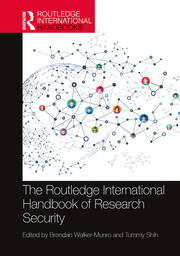
As well as being one of the authors of the Routledge International Handbook of Research Security (above) Associate Professor Brendan Walker-Munro's publications provide some of the most comprehensive Australian perspectives on the challenges and opportunities associated with research security, including:
- 'How is Research Dangerous?': A Study of Australian Universities and Research Security Incidents (co-authored with Abi Young)
- Economic Security and Higher Education: The Rise of Research Securitisation
- Evaluating research security as enterprise risk management
- Research security by roundtable: analysis of Germany’s committees for the ethics of security-relevant research
For a complete overview of his publications, readers are encouraged to consult his Google Scholar profile.
Other influential perspectives include:
 Ross McLennan


 Antonia Hmaidi
- Challenges to research security by Tommy Shih
- Research security policy needs clear guidelines by Caroline S. Wagner and Denis F. Simon
- Challenges and recommendations for research security: Learning from research ethics and integrity by Vasiliki Mollaki, Xenia Ziouvelou, Konstantina Giouvanopolou, Vangelis Karakletsis, and the Changer Consortium.




Research cannot be separated from the people who conduct it. As a result, understanding the national security research environment requires looking beyond traditional security concerns alone. Alongside issues such as foreign interference, dual-use technologies, and research integrity, researchers may also encounter emotionally demanding work that carries significant professional, psychological, and wellbeing implications. While some of these discussions are relatively new to national security research, other disciplines have been wrestling with similar questions for many years. Their experiences, lessons learned, and evidence base have provided valuable insights throughout the writing process.






 Aurthor: Lakomy, M. and Bożek, M.
 Thomas W Gretton, Dr
 Amy Burrell
 University of Birmingham
While universities often dominate these discussions, the underlying challenges are far broader. Research security and researcher safety can affect anyone managing people engaged in national security-related research, from academic supervisors and research directors to policy teams, think tanks, government agencies, and private organisations.
The setting may change, but the safeguarding responsibilities remain remarkably similar.
Because the bottom line is:
Research cannot be separated from the people who conduct it, the institutions that incubate it, or the end-users that depend on it. Securing research means safeguarding the entire research ecosystem.